BALAGOPALAN
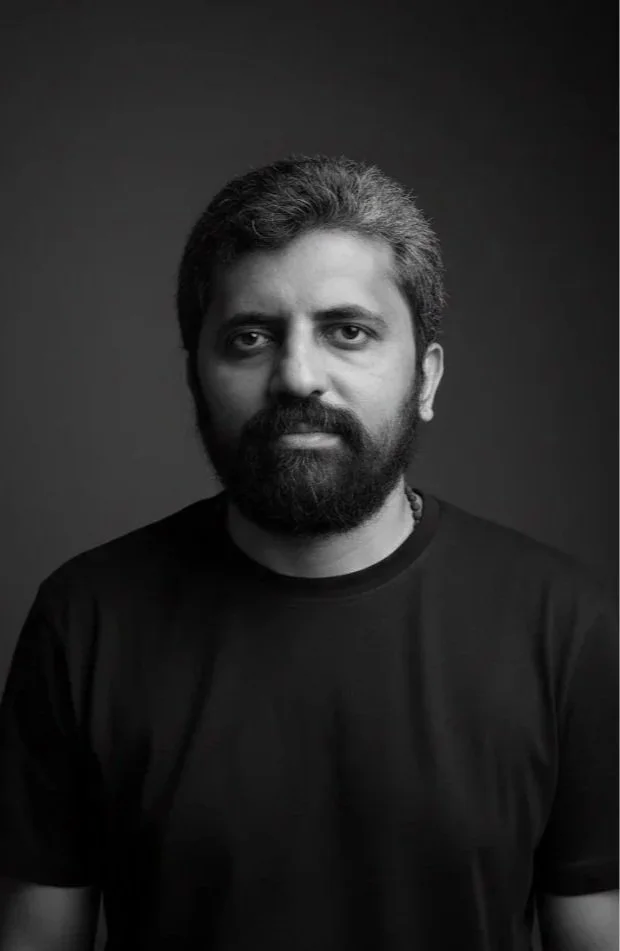
Balagopalan Bethur (b. 1984, Kerala) is a New Delhi–based contemporary artist whose multidisciplinary practice spans sculpture, kinetic installation, painting, video, sound, and photography. Trained in Sculpture at the Chamarajendra Academy of Visual Arts (CAVA), Mysore University (BFA, 2008), his work emerges from an unguarded responsiveness to materials, landscapes, memory, and the unseen. Rather than following a fixed method, Balagopalan treats each artwork as a fresh event—an encounter with forces, intuitions, and questions that cannot be predetermined. His practice evolves from this space of openness, allowing each work to develop its own agency, rhythm, and internal consciousness.
A defining current in his artistic philosophy is rooted in theyyam, the ritual performance and devotional cosmology of his native Kerala. Growing up surrounded by its transformative, transcendent energies, Balagopalan absorbed its understanding of the body as a vessel—an instrument through which something larger, older, and more luminous moves. This informs his refusal to foreground personal identity or ego in his work. Instead, he seeks to channel states of divinity, memory, and cosmic imagination, describing his practice as a form of “drawing from another universe.” His pieces are not expressions of self, but transmissions—moments where material, intuition, and a higher presence converge.
Balagopalan’s attunement to art began early. In the second grade, a teacher saw his graphite copy of Subhash Chandra Bose—drawn from the tiny portrait on a one-rupee coin—and praised him repeatedly. He recalls not knowing whether the drawing was “good or bad,” but the persistence of her praise marked something within him. As he grew older and competed in drawing competitions, he consistently placed third. It was in those moments that he became aware of the silent hierarchies around him: first prizes often went to students backed by established artists, while he remained self-taught. Today, he notes—half amused, half philosophical—that many of those early winners left the arts entirely, while he continued his path, sustained by an inner calling rather than external validation.
This clarity deepened as he traveled across India, working in cinema productions, observing regional craftspeople, and spending time in ashrams studying spiritual philosophy. Deeply moved by Steve Jobs’ own spiritual pursuits and by artists such as Agnes Denes, Zarina Hashmi, and visionary companies like SpaceX, Balagopalan’s work merges the meditative with the futuristic, the handmade with the conceptual. For him, art is a continuum—ancient, living, and future-bound.
His materials reveal this hybridity. He pairs organic and industrial substances, traditional craft processes with contemporary visual languages, and slow, devotional labor with kinetic or mechanical systems. His works often hold a quiet tension—between transformation and stillness, the animate and the inanimate, the ecological and the spiritual. Rather than closing meaning, his pieces open spaces for uncertainty and encounter, inviting viewers to pause, listen, and re-sense their own relationship to matter and environment.
His 2024 solo exhibition A Story of The Sea to the River, curated by Sumesh Manoj Sharma at Sculpture Garden Camellias, AnamKara Art, situated ecological narratives within sculptural constellations that spoke to interdependence, erosion, and continuity. Earlier solo presentations include Ezhuthu (2021), Kerala Lalithkala Akademi, Kozhikode; Epiphany (2016), Apparao Art Galleries, New Delhi; and his debut solo at CAVA Art Gallery (2008). His work has appeared widely in group exhibitions including Temporal Resonance (2025); Lokame Tharavadu (2021), curated by Bose Krishnamachari; The Signature in the Image (2020), Art Centrix Space; and international projects across Sri Lanka, Bangladesh, and digital platforms.
Balagopalan is also deeply committed to collaborative and socially engaged art. His steel public sculpture at Zorba the Buddha (2024), his collaborative performance Marks (2021), and his pivotal contributions to Project Tihar (2017)—working with 100 inmates at Tihar Central Jail under the curatorship of Veer Munshi—demonstrate his belief in art as collective process and shared transformation.
He has been awarded numerous residencies and grants, including the Shrishti–American Indian Foundation Grant and Residency (2020), Kalakriti Art Residency (2020), CRACK International Art Camp (2019), Open Hand Art Studios Scholarship (2018), and the Kochi Biennale Foundation Residency (2015).
Despite invitations from his family to pursue opportunities abroad, Balagopalan remains committed to India as a place of immense creative and manufacturing potential. A humorous but telling memory—the moment he mistook a sleek Dubai trash bin for a public sculpture—reinforces his conviction that India’s aesthetic future remains largely unwritten. He often says that since the Taj Mahal, the country has not produced a monumental public artwork of equivalent cultural resonance. His ambition is to change that: to build work on a civic, architectural, and spiritual scale that reflects the complexity and beauty of contemporary India.