ABOUT
Chet Na
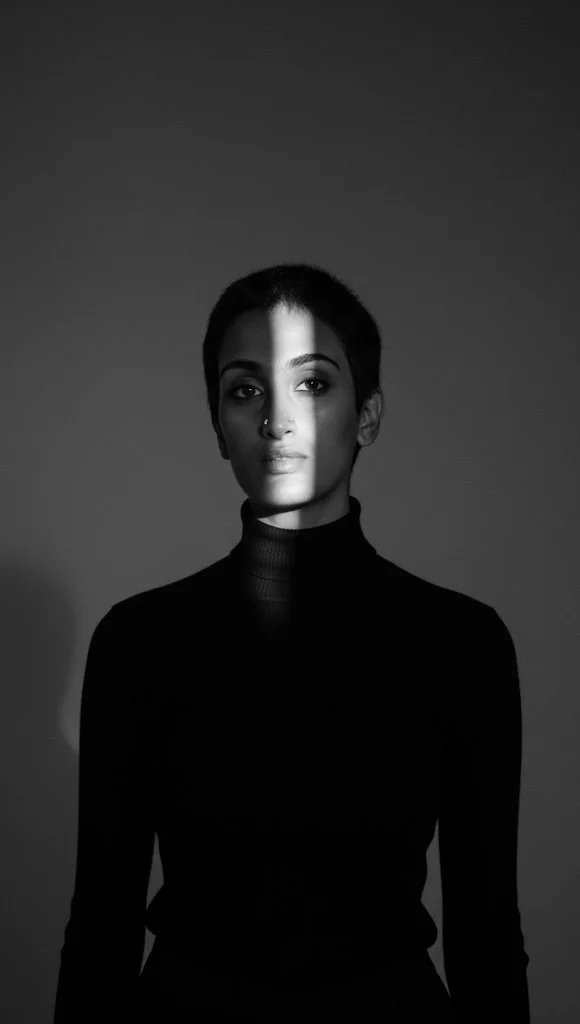
Born in Hyderabad and raised in the U.S. from the age of four, Chetna Ayyagari has spent her life on the American East Coast. Growing up across Pennsylvania, New Hampshire, and Massachusetts, she began her artistic path in Bharatanatyam, a classical Indian dance form against the New England backdrop of software engineering immigrants of South India. Dance taught her devotion, rigor, and storytelling as well as how her body could become a museum that held the language, movement, and tradition of her ethnic ancestors. From there, she evolved into painting, photography, and film, always searching for new languages of expression.
She attended the Cambridge School of Weston, an arts-focused high school in Weston, Massachusetts and originally planned to study political science and pursue law. But a deepening pull toward the creative world led her further into art instead. She continued to search for a path that would combine her interest of abstraction with her hunger for tangible production.
During a gap year before college, she worked at MIT’s List Visual Arts Center and took a course in intellectual property law, which sparked her interest in transcultural art business and the ethics of creative ownership.
Her young adulthood was marked by rebellion and experimentation. Expelled from high school months before graduation for drug and alcohol use, she carried her search for altered states and spiritual vision into college, where her substance use and alcoholism peaked. Though her academic performance suffered, she believed her art reached new heights. By graduation, law school was no longer an option—but a different path was taking shape.
Driven to reconnect with her origins, Chetna moved to India to study dance. What she hoped would resolve her cultural dislocation only became more entropic. Seen as American in the country of her birth, she found herself in an even deeper state of in-betweenness.
While in India, she worked on nonprofit projects that supported artisan-led fashion brands, helping them reposition themselves as cultural relics rather than commercial luxury. She also wrote on the intersection of art, technology, and the evolving Indian marketplace, exploring how tradition and innovation collide in global markets.
Her time there was also marked by profound personal loss—a miscarriage and the death of her partner to addiction. These turning points begged her to question if art could be her crucible or her testament.
Returning to the United States, having undergone a drug rehabilitation treatment program and now in A.A., Chetna stepped into her ultimate calling of advocacy, storytelling, and creative patronage. She is building Chetna Gallery as a global platform for abstract art—especially for artists shaped by hybridity, spiritual searching, migration, trauma, and myth.
For her, the gallery is not just a space, but a lived philosophy: art as survival, art as trance, art as testimony. As both founder and artist, she works at the intersection of cultural memory, abstraction, and radical imagination—building a bridge for others who create from the margins and the in-between.
Chetna refuses to choose one identity, one medium, or one story. She is building a home for all of them.